The usual problem
Most software asks the business to adapt. We do the opposite.
Off-the-shelf tools are built for a generic version of a business. They are fine until the work has its own order, its own exceptions, and its own way of getting from a request to a finished job.
That is usually when owners start saying the same things: this has to be done by hand every day. The current software does not work the way we work. Three programs are doing a job that should be one system.
Tempest Labs builds the missing piece — or replaces the pile of pieces — so the software follows the workflow instead of fighting it.
What this can look like
Built for the work, not for a feature list.
Every project is different. These are the kinds of systems we most often build for small businesses.
- Customer management
- A single place for contact details, history, notes, and what still needs to happen next.
- Job tracking
- See where each job stands without asking around or hunting through messages.
- Order management
- From request to fulfillment, with the status visible to the people who need it.
- Scheduling
- Appointment and calendar tools that match how you book, cancel, and run a day.
- Digital intake
- Customers give you the information once. Your team starts with a complete record.
- Inventory
- Know what you have, what you used, and what needs to be ordered before you run out.
- Custom reporting
- Numbers that answer the questions you actually ask — not a generic export.
- Internal applications
- Small, focused tools for the one process that never fit anything you tried to buy.
- Connecting existing systems
- If two tools already work, they can share information instead of making someone retype it.
Mobile and internal tools
The software has to work for the people who will actually use it.
That often means more than a screen on an office computer. Staff need tools on the floor. Customers need a simple way in. Owners need a view that does not require a briefing.
Staff
Clear screens for the day's jobs, updates, and handoffs — built so people do not need a training manual. Phone and tablet tools for field work or a shop that does not live at a desk.
The goal is less asking around, and fewer notes that only one person understands.
Customers
Portals and mobile apps so customers can check status, submit details, browse services, or pay without adding work at the counter.
Let them take the first steps themselves so the front desk is not answering the same questions all day.
Owners
Admin dashboards and simple reporting that show what is open, what is late, and what needs a decision.
A view of how the business is running that does not start with exporting five files.
How we design it
We map the workflow before we pick the screens.
The first conversation is not about technology. It is about the process: who starts it, what information is needed, where it stalls, and what “done” looks like.
Then we build only what that process needs. A scheduling tool does not have to become a platform. An intake form does not have to become a second business. The goal is software people will use on a Tuesday afternoon when they are busy.
- We start with the real workflow, including the messy parts.
- We keep the system understandable for the people who will run it.
- We build it so it can be maintained after launch, not just demoed once.
In use
Hem Over Heels needed a better customer path, not another brochure.
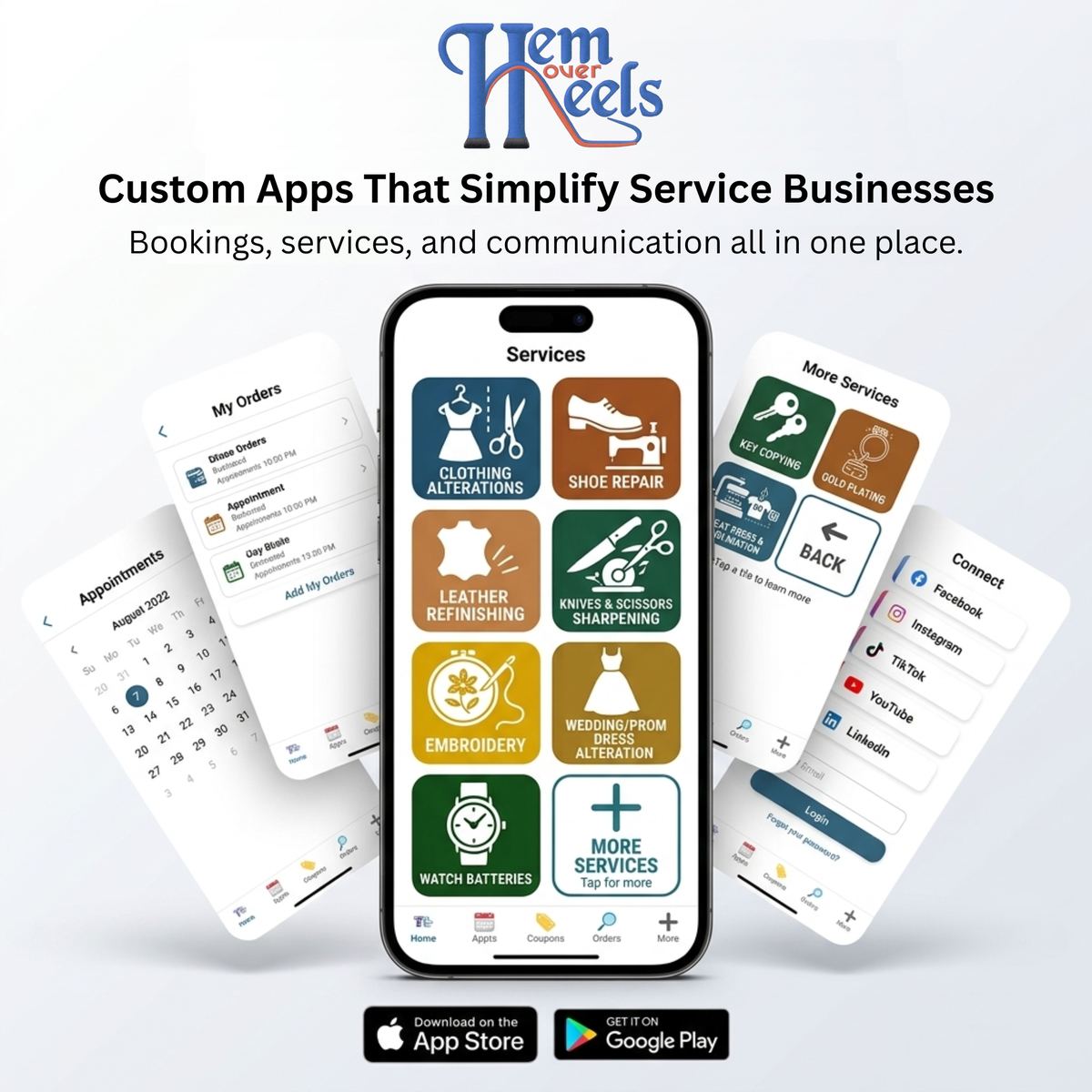
A mobile app for a working shop
Customers browse services, reach the business, and pay from their phone. The front desk spends less time on interruptions during peak hours.
Start with the problem
If the current software does not fit the work, we can build what does.
You do not need a technical brief. Describe the process. We will tell you whether custom software is the right fix.